How could a speaker use a DM grammar?
Distributed Morphology as a production architecture
Utku Turk
LING 449U, How words are built
2026-10-01
First, an ordinary DM tree
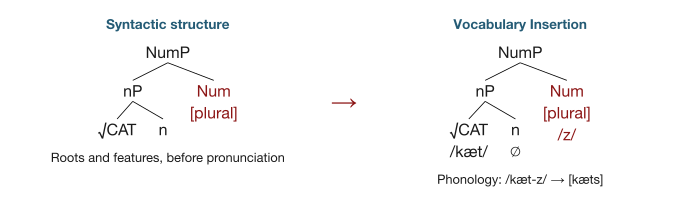
cats: a root, a nominal categorizer, and plural Number.
![Before insertion, NumP contains nP with root CAT and n, plus Num plural. After insertion the same nodes receive kæt, zero, and z. Phonology yields cats.]()
The hierarchy stays the same here. Pronunciation is supplied at PF.
Why leave room for morphological operations?
Syntax and pronunciation may package features differently.
| Fusion |
Two terminals become one insertion site. |
| Fission |
One terminal supports more than one insertion site. |
| Impoverishment |
A feature is deleted before insertion. |
Fusion: two terminals, one insertion site
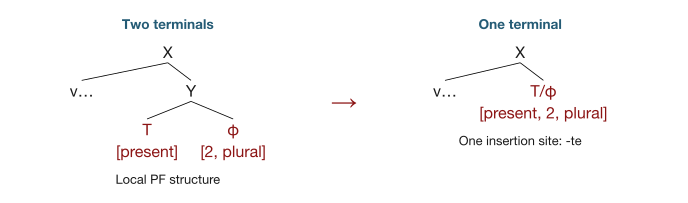
Italian am-a-te, ‘you.PL love’, present indicative.
![A local PF subtree with separate T present and phi second-person plural becomes a subtree with a single T/phi terminal carrying present, second person, and plural.]()
The features survive; their packaging changes.
Fission: one terminal, two insertion sites
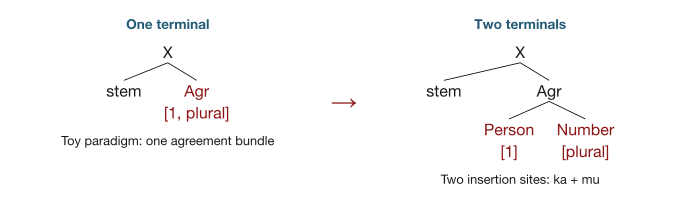
Toy paradigm: one agreement bundle, two endings.
![Agr first-person plural under X splits into Person first and Number plural, realized separately as ka and mu. This is an invented paradigm.]()
ka ↔︎ [1st person] · mu ↔︎ [plural] → stem-ka-mu
Impoverishment: fewer features at PF
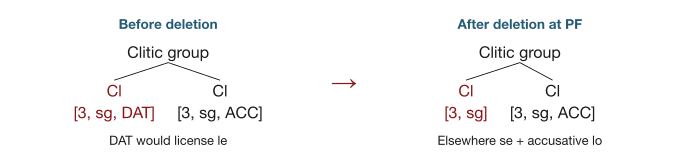
Spanish le dio un libro, ‘gave her a book’, but se lo dio, ‘gave it to her’.
![In a simplified Spanish clitic analysis, DAT is removed from the first clitic before an accusative clitic. Both nodes remain, but the first no longer licenses le; se appears instead.]()
Delete [DAT] before an accusative clitic → se lo, not *le lo.
What changed?
| Ordinary insertion |
Same |
Same |
| Fusion |
Fewer |
Combined |
| Fission, as drawn |
More |
Distributed across sites |
| Impoverishment |
Same in our example |
Reduced |
Your turn: record
Keep a record of the meeting.
Please record the meeting.
- Draw a syntactic tree for each use in DM.
- State what is shared and what differs in the two structures.
- Propose a rule for the pronunciation in each context, including stress.
An answer: record
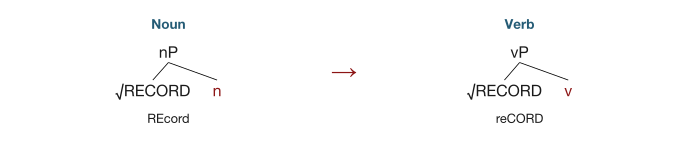
![Root RECORD combines with n in the noun and v in the verb. The noun has initial stress; the verb has final stress.]()
For √RECORD:
- In an n context, stress the first syllable: REcord.
- In a v context, stress the second syllable: reCORD.
The vowels also differ: /ˈrɛkɚd/ versus /rɪˈkɔɹd/.
Your turn: separate
The files are separate.
Please separate the files.
- Draw a syntactic tree for each use in DM.
- Identify the shared root and the different categorizing heads.
- Propose a pronunciation rule for the final syllable. Does stress change?
An answer: separate
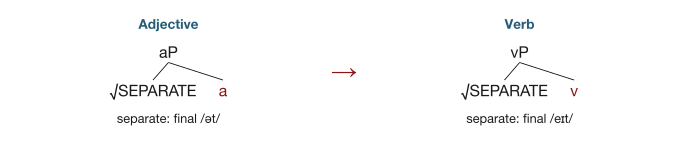
![Root SEPARATE combines with a in the adjective and v in the verb. The adjective ends in schwa-t; the verb ends in ay-t.]()
For √SEPARATE:
- In an a context, realize the ending as /ət/.
- In a v context, realize the ending as /eɪt/.
Both forms retain initial primary stress.
Your turn: nominalizations
arrive → arrival
collect → collection
destroy → destruction
- Draw a DM tree for each noun.
- State a rule choosing the nominal suffix in each context.
- Explain any changes needed in the stem or its pronunciation.
An answer: nominalizations
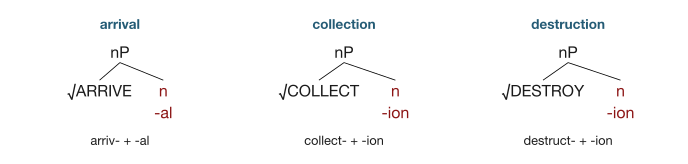
![Nominal heads combine with ARRIVE, COLLECT, and DESTROY. Their suffixes are al, ion, and ion; DESTROY uses the stem destruct-.]()
- n → -al with √ARRIVE; n → -ion with √COLLECT and √DESTROY.
- √DESTROY → destruct- in this nominal context.
- Stem-suffix phonology gives collection /kəˈlɛkʃən/ and destruction /dɪˈstrʌkʃən/.
Why connect DM to production?
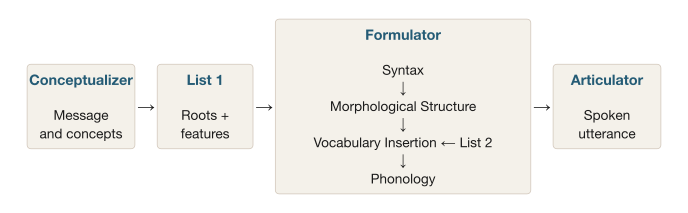
Both accounts distinguish building a grammatical representation from giving it a pronunciation.
| What gets selected? |
Roots and grammatical features |
| How does it combine? |
Syntax and morphological operations |
| How does it sound? |
Vocabulary Insertion and phonology |
What changes from a lemma-based account?
| Select a lemma with grammatical properties. |
Select an abstract root and grammatical features. |
| Use lexical information to build the utterance. |
Combine roots with functional structure. |
| Retrieve the phonological form. |
Insert exponents into the resulting structure. |
A root does not already contain its final category and inflected form.
Late pronunciation still needs early root identity
Selecting √KATZ ‘cat’ is different from selecting a generic ROOT slot.
- The intended concept activates a particular root.
- Syntax combines that root with grammatical structure.
- Vocabulary Insertion supplies the appropriate pronunciation.
1. Start with the message
We want to say: Die Katzen schnurren.
‘The cats are purring.’
- We are talking about cats.
- There is more than one.
- The listener can identify which cats.
- They are purring now.
2. Select roots and grammatical features
| Cats; purring |
√KATZ, √SCHNURR |
| More than one cat |
[plural], associated with √KATZ |
| Identifiable referents |
D[definite] |
| Present time in this example |
T[−past] |
These are abstract inputs. Their pronunciations have not been inserted.
3. Build the nominal structure
Combine √KATZ with the nominal categorizer n.
![Root KATZ combines with n, highlighted in red, to form nP.]()
The result is nP: a root in a nominal context.
4. Add plural Number
Combine the nominal structure with Num[plural].
![Num plural is added above the existing nP containing root KATZ and n.]()
The structure now refers to multiple cats. [plural] is still a feature.
5. Add definiteness
Combine D[definite] with the plural nominal structure.
![D definite is added above the existing NumP, creating a DP for the identifiable plural cats.]()
This DP identifies the cats the speaker is talking about.
6. Build the predicate and add its subject
Combine √SCHNURR with v, and place the cats’ DP in the subject position.
![A vP contains the already built subject DP and a verbal structure made from root SCHNURR and v. A triangle abbreviates the subject's internal structure.]()
The structure connects who is purring with the purring event.
7. Add tense
Combine the predicate with T[−past], appropriate to the present-time message.
![T minus past is added above the vP containing the subject DP and the purring predicate. T appears to the right before movement.]()
The clause now contains both the event and its temporal specification.
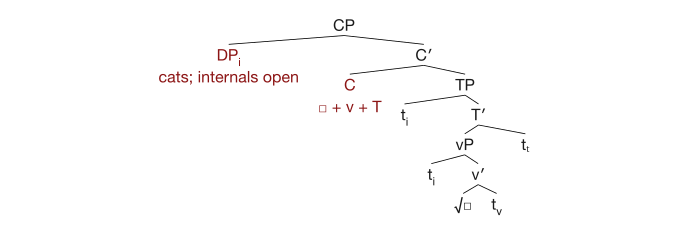
8. Establish the main-clause order
The verbal head raises through v → T → C. The subject DP moves to the front.
![In the resulting CP, the subject DP occupies the first position and C contains the complex verbal head root SCHNURR plus v and T. A lower TP contains unpronounced copies.]()
Result: subject DP + finite verbal head.
9. Add an agreement site
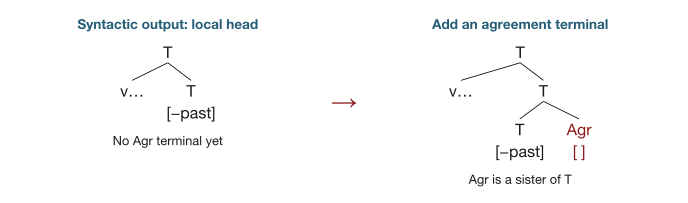
On the pronunciation branch, add Agr, an agreement terminal next to T.
![A local verbal head first has v and T minus past. Morphology adds an empty Agr terminal as a sister of T.]()
There is now a place for the verb’s agreement features.
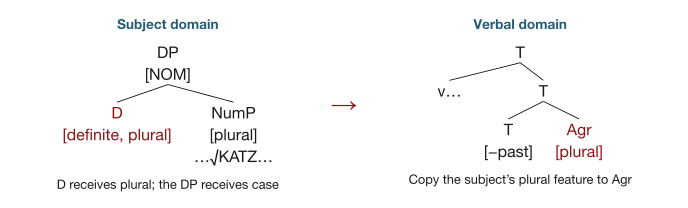
10. Copy number; assign case
Copy [plural] from the subject onto Agr and D.
![In the subject domain, D receives plural from the nominal structure and the DP has nominative case. In the verbal domain, Agr receives the subject's plural feature.]()
The subject DP also receives nominative case from its clausal context.
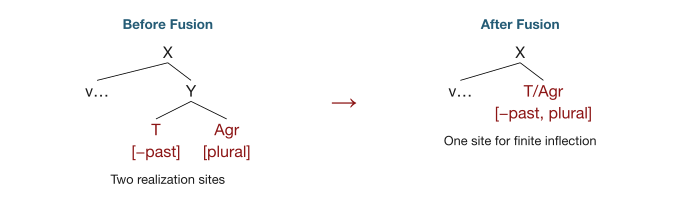
11. Fuse tense and agreement
Combine the adjacent T and Agr terminals into one realization site.
![Separate T minus past and Agr plural terminals fuse into one T/Agr terminal containing both features.]()
[−past] and [plural] both survive.
12. Insert the root pronunciations
The Vocabulary supplies forms for the selected roots in their grammatical contexts.
| √KATZ in the nominal context |
/katsə/, Katze |
| √SCHNURR in the verbal context |
/ʃnʊr/, schnurr- |
These pronunciations realize the roots that were selected earlier.
13. Realize the grammatical features
| D[definite, plural], nominative context |
/diː/ |
die |
| Nominal [plural], with √KATZ |
/-n/ |
Katze-n |
| T/Agr[−past, plural], verbal context |
/-ən/ |
schnurr-en |
The two plural endings have different forms and different insertion contexts.
14. Prepare and articulate the sound sequence
/diː/ + /katsə/ + /n/ + /ʃnʊr/ + /ən/
↓
Die Katze-n schnurr-en.
‘The cats are purring.’
Phonology organizes the spoken forms. The articulator executes the plan.
Must planning follow the derivation?
We built nP → NumP → DP, then a clause, then movement.
Does a speaker have to plan it in that order?
Could planning begin with where the constituents will end up, with their lower positions already linked to those destinations?
Could a familiar frame be ready to reuse?
Suppose a speaker often uses this pattern:
[subject DP] + [finite verb] + …
Could its structure become familiar enough to retrieve as a frame, with places for new roots and features?
How much of the sentence would still need to be planned?
Plan the destination and its lower positions
Place the cats’ DPᵢ at its planned destination; reserve its lower positions.
![A proposed CP planning frame has a subject DP at the front and an unfilled verbal complex in C. Below C, TP contains a linked subject trace and T prime. Inside T prime, vP contains another subject trace and a verbal structure with an unfilled root and a lower v trace. A lower T trace is also reserved. The DP's internal structure remains unfilled.]()
Filled: the subject’s identity and destination. Open: internal content.
How much structure comes with a trace?
Do we plan only the lower positions, or their surroundings too?
| Dependency links |
A destination and its linked lower positions. |
| Local structure |
Those positions plus sisters, complements, and attachment sites. |
| A fuller frame |
Clause structure, argument positions, and feature relations. |
Where would you leave the tree underspecified?
What would distinguish these planning options?
Compare reuse of surface order, movement dependencies, and complement structure.
- Would the same order help when the predicate needs different complements?
- Would a frame help before its roots and number features are selected?
- Which unfilled positions could remain open when speaking begins?
A reusable plan must still supply what DM needs for realization.
Now let something go wrong
Intended: “I wanted to tie up the dog.”
Produced: “I wanted to bark at the dog.”
German: anbind-en ‘tie up’ → anbell-en ‘bark at’.
The concept DOG can activate a related, unintended action.
Which part of the model needs access to these conceptual associations?
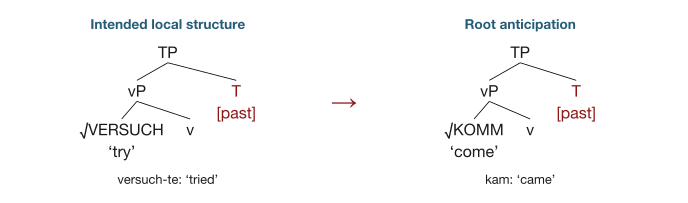
A wrong root can get the right morphology
Intended: versuchte … zu kommen, ‘tried … to come’.
Error onset: kam, ‘came’.
![A simplified TP keeps T past fixed while root VERSUCH, try, is replaced by anticipated root KOMM, come. The resulting past form is kam.]()
The displaced root is pronounced in its new grammatical context.
What exactly was left behind?
| Intended |
√VERSUCH ‘try’ |
versuch-te |
| Error |
√KOMM ‘come’ |
kam |
The stranded element is [past]. Its pronunciation depends on the root that occupies the context.
Why would “the speaker just kept the suffix -te” miss the pattern?
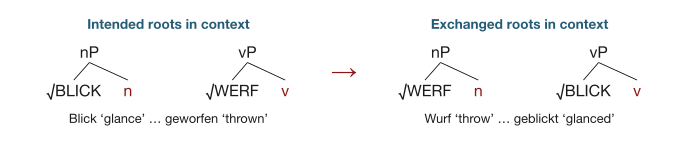
A root can also land in a new category
Intended: einen Blick geworfen, ‘thrown a glance’.
Produced: einen Wurf geblickt, approximately ‘glanced a throw’.
![The intended nominal root BLICK and verbal root WERF exchange contexts. WERF under n is realized as Wurf; BLICK under v receives the participial realization geblickt.]()
The grammar keeps working after an error
| √KOMM in a past context |
Past realization: kam |
| √WERF in a nominal context |
Nominal realization: Wurf |
| √BLICK in a participial verbal context |
Participial realization: geblickt |
Accommodation: the produced form fits the context created by the error.
Your turn: roots, tense, and pronunciation
| Intended |
schien ‘seemed’ |
zu drohen ‘to threaten’ |
| Produced |
drohte ‘threatened’ |
zu scheinen ‘to seem’ |
- What moved between the two positions?
- What stayed in the finite position?
- What determines the two new pronunciations?
What does this architecture explain?
- Selection: the message activates specific abstract roots and features.
- Combination: syntax places roots in grammatical contexts.
- Realization: ordinary morphology produces context-appropriate forms, even when an earlier choice was wrong.
Explain kam using these three steps. Where did the error occur?
Do roots and features need separate stores?
A speaker can produce the wrong root with the intended inflection, or the intended root with the wrong inflection.
| Root store |
Lexical content |
| Feature store |
Grammatical specifications |
| Vocabulary |
Phonological exponents |
Independent errors can motivate separate representations.
Revising a developing utterance
“The girl reads … writes a letter.”
Conceptual planning ⇄ DM formulation ⇄ Local phonology → Articulation
Cognitive control can influence selection, mapping, and revision.
Which choice could be revised while the rest of the structure stays available?
Exit ticket
- Where does DM fit into this production architecture?
- Why must a root’s identity be available before its pronunciation?
- In versuchte → kam, what changes and what stays?
- Why can the error’s morphology follow from ordinary realization?
Sources: DM and production
Further reading: possible implementations
Extension: the same derivation in vectors
Die Katzen schnurren.
- Maintain small pieces of structure, such as the subject DP and the finite verbal head.
- Give roots and features content vectors.
- Bind those vectors to positions within the structure.
The representations can be numerical while retaining grammatical distinctions.
A position is a role in the tree
![A local tree for the nominal KATZ root labels NumP with the root address epsilon, nP with L, Num plural with R, KATZ with LL, and n with LR.]()
ε = root position · L = left branch · R = right branch
Bind a node’s content to its path. The same root could occupy a different path.
Bind content; retrieve with a position
\[
W = \sum_i \mathbf{v}_i\mathbf{p}_i^{\mathsf T}
\qquad
\widehat{\mathbf{v}}_i = W\mathbf{p}_i
\]
\(\mathbf{v}_i\): what occupies a node. \(\mathbf{p}_i\): where it belongs.
| Subject’s nominal root position |
√KATZ |
| Subject’s Number position |
[plural] |
| Finite head’s verbal root position |
√SCHNURR |
| Tense position |
[−past] |
A numerical example: copy plural to agreement
Columns are Num and Agr. Rows are plural and nonpast.
\[
W_{\text{before}}=
\begin{bmatrix}1&0\\0&0\end{bmatrix}
\quad\longrightarrow\quad
W_{\text{after}}=
\begin{bmatrix}1&1\\0&0\end{bmatrix}
\]
Cue the Agr column: \(W_{\text{after}}\begin{bmatrix}0\\1\end{bmatrix}
=\begin{bmatrix}1\\0\end{bmatrix}\) → [plural].
Number remains on the noun and is now available for verbal agreement.
Morphological operations become changes to bindings
| Fusion |
Replace two terminal bindings with one combined feature bundle. |
| Fission |
Rebind specified parts of one bundle to separate terminals. |
| Impoverishment |
Remove a specified feature from a PF-side content vector. |
For our verb: T [0, 1] + Agr [1, 0] → T/Agr [1, 1].
Retrieve the bindings and realize them
| √KATZ, nominal context |
/katsə/ |
| [plural], at this nominal site |
/n/ |
| √SCHNURR, verbal context |
/ʃnʊr/ |
| [plural], at fused T/Agr |
/ən/ |
Together with D → /diː/: Die Katzen schnurren.
Begin with controlled morphological contrasts
| Singular |
Die Katze |
schnurrt |
| Plural |
Die Katzen |
schnurren |
| Singular |
Der Hund |
bellt |
| Plural |
Die Hunde |
bellen |
Train an analysis on some roots; test it on different roots and forms.
Find a candidate number direction
At layer \(\ell\), compare paired representations:
\[
\mathbf{d}_{\ell}=\operatorname{mean}_{\text{pairs}}
\left(\mathbf{h}_{\ell,\mathrm{PL}}-
\mathbf{h}_{\ell,\mathrm{SG}}\right).
\]
Can a simple readout recover number for roots it has never seen in training?
Then ask which head outputs and layers carry or transform that information.
What would connect the findings back to DM?
| Number can be decoded across roots. |
A reusable grammatical distinction. |
| A selective intervention changes inflection. |
That information contributes to form choice. |
| The same feature predicts different exponents in different contexts. |
Context-sensitive realization. |
Identifying Fusion, Fission, or Impoverishment would require additional, operation-specific tests.
Sources for the vector and LLM extension