What can we prepare before speaking?
Roelofs (2000)
LING 449U, How words are built
2026-09-22
The conditions: cue, response, shared part
Each row is a three-pair block. Learn cue → response; then see only the cue and say its response.
| Cue | Response | Condition name | Shared |
|---|---|---|---|
| religie haast spoor |
bijbel bijna bijster |
Syllable: shared | Initial syllable bij |
| religie brein dicht |
bijbel hersens nader |
Syllable: mixed | No common beginning |
| studie toneel long |
bijvak bijrol bijnier |
Morpheme: shared | Initial morpheme bij |
| toneel steiger mond |
bijrol herbouw nasmaak |
Morpheme: mixed | No common beginning |
religie → bijbel: religion → bible
toneel → bijrol: stage → supporting role
Actual materials: Roelofs 1996, Experiment 1, Table 1, p. 862; example blocks
Read the result
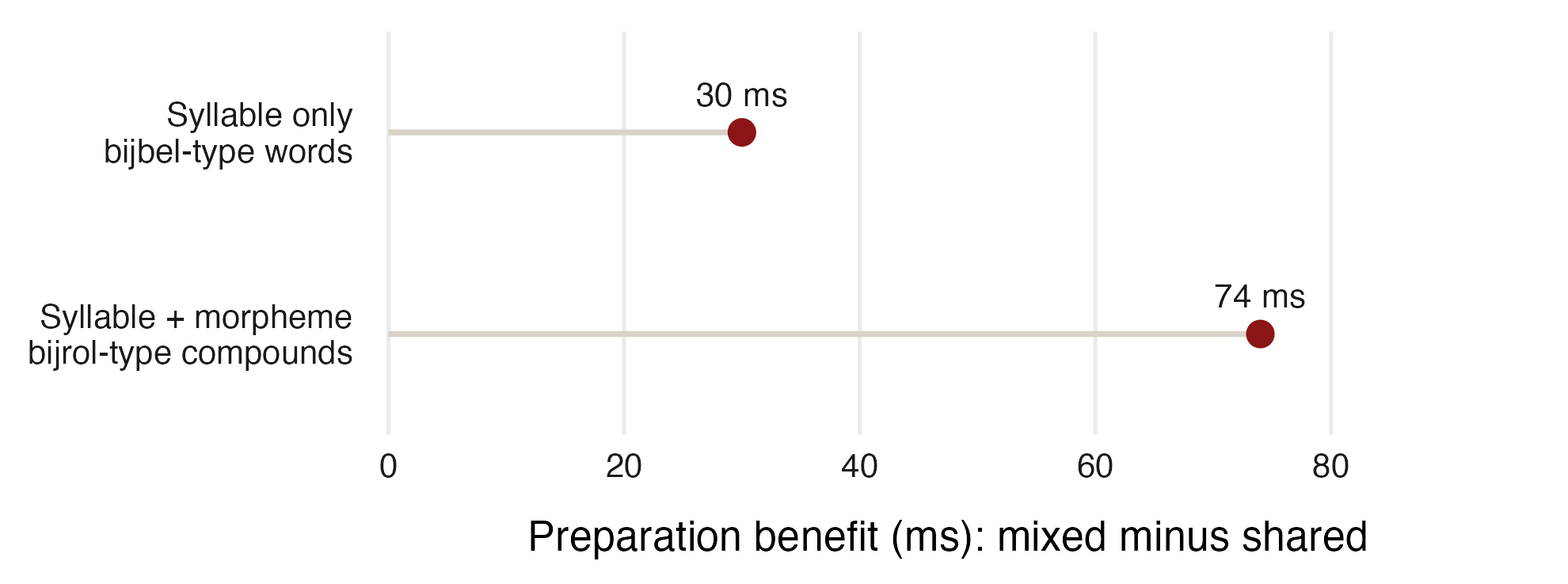
Higher = more time saved. Both groups benefit; the compound group benefits more.
Both groups share the sounds bij. What could explain the extra benefit?
Roelofs 1996, Experiment 1, Table 2, p. 863; reviewed in Roelofs 2000, pp. 98 to 99
What must a model explain?
- Units: preparing a morpheme saves more time than preparing its sounds alone.
- Order: in further experiments, a shared later morpheme, such as rol in bijrol, gave no preparation benefit.
What can be completed before the cue, and why must preparation start at the beginning?
Roelofs 2000, pp. 98 to 99
WEAVER++: select, then encode
Concept → lemma + features → morphemes → sounds → speech
- A lemma supplies grammatical information; normally, only the selected lemma starts form encoding.
- Verification checks that a candidate belongs to the selected word. Activation affects how long selection takes.
- Rightward incrementality: build the sound plan from the beginning, pause, then resume when more is known.
For bijrol: prepare the morpheme bij and its syllable.
For bijbel: prepare the syllable only.
Roelofs 2000, pp. 83 to 87, 93 to 98; simplified production sequence
Dell: activation with feedback
Conceptual features ↔︎ lemmas ↔︎ morphemes ↔︎ sounds
- Activation spreads down and back up; shared sounds can support a word.
- At scheduled selection times, the most active eligible unit fills a slot.
- This helps explain mixed errors: rat for cat shares meaning and sounds.
Roelofs 2000, pp. 76 to 81; classical Dell model, simplified
Same units, different selection mechanisms
| Classical Dell | WEAVER++ | |
|---|---|---|
| Sounds feed back to word selection? | Yes | No |
| Selection | Most active eligible unit at a scheduled time | Activation plus verification; time varies |
| Main evidence explained | Speech-error patterns | Production-time patterns |
Which mechanism explains why advance preparation changes response time?
Roelofs 2000, pp. 80 to 87, 98; comparison of the versions reviewed here
Your Questions
Try it: prepare a grammatical form
Open the experiment · Choose Grammar
See GO and “Yesterday, I ___ home.” Say only went.
| Condition | Example responses | Shared |
|---|---|---|
| Same grammatical context | went, ate, bought | Simple past; no common affix |
| Mixed grammatical contexts | went, eat, bought | Past, habitual present, present perfect |
Was it easier to stay in one grammatical context?
In a shared past-tense block, you knew past tense before seeing the verb. The responses went, ate, bought share no common affix.
Did switching grammatical contexts make it harder to get ready?
Model question: can we prepare grammatical information before its word form?