From a word to its sounds
Griffin & Ferreira (2006), sections 1.3 to 1.5
LING 449U, How words are built
2026-09-08
Where we got to
- Two stages. Wrong word said perfectly vs. right word scrambled.
- A family activates. van wakes up bus.
- They compete. Two good names (TV, television) makes you slower.
- Class fences the competition. Nouns replace nouns.
- Meaning properties matter. vampire beats spirit, and gets replaced more often.
- Intention to name. An ignored banana does not interfere; a written banana does.
- Selection leaves a trace. Name a zebra, then call the giraffe zebra.
- It can fail halfway. TOT: gender and syllable count, no form.
The one result to keep
picture
distractor
-400 ms -200 0 +200 +400
- Early distractor, semantic relation: interference. Selection is running.
- Late distractor, phonological relation: facilitation. Sounds are running.
Same picture, same distractor, different SOA, opposite sign. The timing is the evidence for the stages.
Schriefers, Meyer & Levelt 1990
Today
- 1.3, function words and morphemes (9)
- 1.4, assembling the sounds (10 to 13)
- 1.5, time course (14 and 15)
Property 9 is the only place in the whole chapter where inflection gets a paragraph. We are going to sit on it for a while.
1.3 Function words and morphemes
Some words and morphemes are not selected by meaning. They are selected by the words around them.
- English: some pasta vs. a noodle, count or mass.
- Swedish: ett bord vs. en stol, gender.
- French: mon chapeau, ma table, but mon ampoule, gender and phonology.
Property 9. Janssen & Caramazza 2003
The evidence
- Gender interference. Dutch het groene huis is slowed by the distractor tafel (de) more than by been (het).
- Agrammatism. Function words are impaired even though they are frequent and phonologically simple.
- Speech errors. Function words slip differently from content words.
Schriefers 1993; Bates, Wulfeck & MacWhinney 1991; Garrett 1975; Dell 1990
Two ways to get a function word
Positional frames (Garrett)
Function words are part of the frame content words get slotted into.
Retrieved by a different route than nouns, but sensitive to meaning.
Indirect election (Levelt, Ferreira)
Retrieve the noun first. The noun’s syntactic knowledge then triggers the determiner.
Word first, then its dependents.
Both deny direct meaning-to-function-word mapping. They disagree on whether the frame exists before the content word does.
Property 9: what this is doing to us
- The chapter’s split is content vs. function. Where does -ed go? It is not a word, and it is not free.
- If the noun triggers the determiner, what triggers plural -s on that noun?
- Is a positional frame a syntactic structure, or a phonological one?
1.4 The sounds are built anew
- Not retrieved as intact wholes. Assembled every single time.
- hand alone vs. hand it = “han-dit”. The /d/ resyllabifies.
- Repeating kem-til-fer is faster than kem-til-ner: shared CVC structure, different content.
The stored thing is not a pronunciation. It is a set of segments plus a metrical frame, put together on the spot.
Property 10. Levelt et al. 1999; Sevald, Dell & Cole 1995
Property 11: experience shapes the errors
- Lexical bias. Slips make real words more often than chance.
- Position constraints. New sequences still respect syllable position.
- Least predictable slips. Word-initial /b/ in bicycle separates more easily than the /s/ and /k/. Pig Latin, helter skelter.
So which consonant slips should depend on which language you speak.
Baars, Motley & MacKay 1975; Dell & Reich 1981; Shattuck-Hufnagel 1987
The same slip, two languages
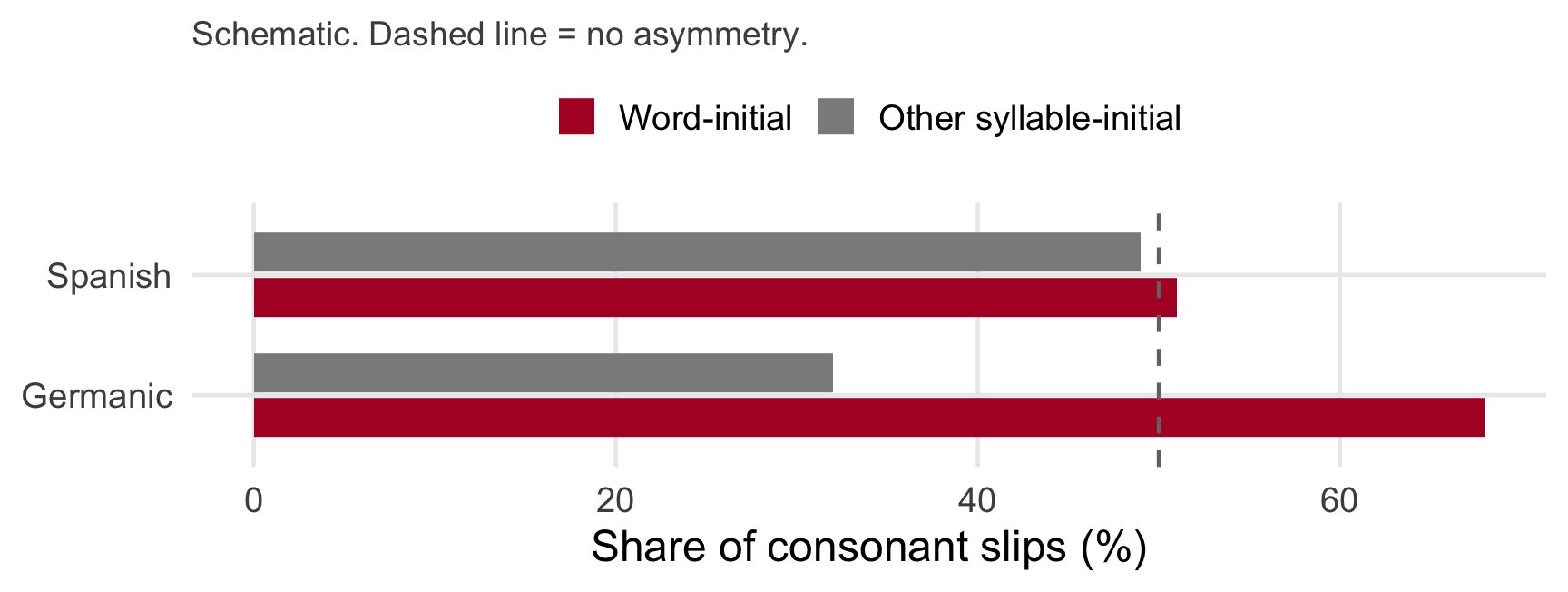
Spanish does not distinguish word-initial from other syllable-initial consonants, and Spanish slips do not either.
Berg 1991, 1998; Shattuck-Hufnagel 1987
Property 11: two timescales
- Short term. If /f/ only appears syllable-initially inside one experiment, slips involving /f/ go syllable-initial within an hour.
- Long term. Frequency and age of acquisition: common words come out up to 100 ms faster.
So where in the system does frequency live?
Dell, Reed, Adams & Meyer 2000; Oldfield & Wingfield 1964
Where frequency bites
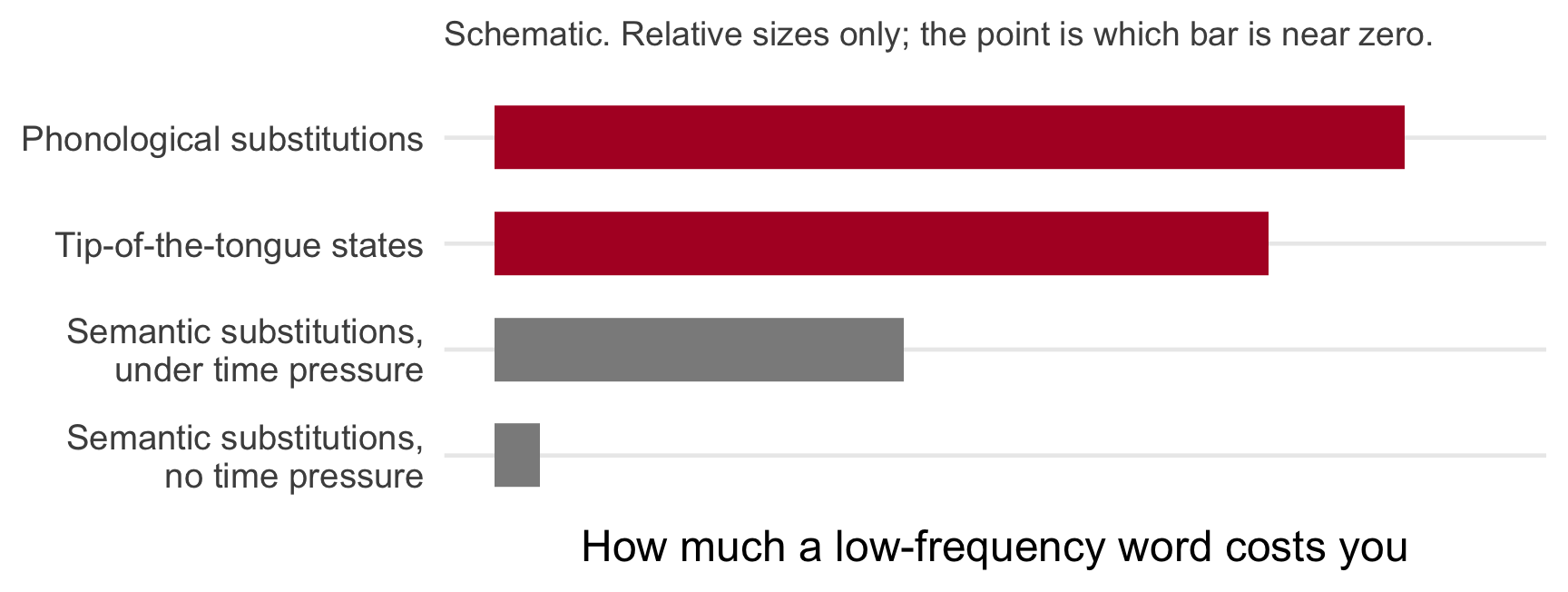
Frequency looks like a phonological encoding effect, not a selection effect.
Dell 1990; Stemberger & MacWhinney 1986; Vitkovitch & Humphreys 1991
Property 11: homophones
ball the object and ball the dance: different meanings, same sounds.
- The rare ball slips less than equally rare words.
- Practicing one meaning helps an aphasic produce the other, for a week.
- cherry pit resolves a TOT for Brad Pitt.
Shared phonology, separate lexical entries. This is the cleanest case in the chapter of one form serving two meanings, and the chapter never asks what happens when one meaning has two forms.
Dell 1990; Biedermann, Blanken & Nickels 2002; Burke et al. 2004
Property 12: sounds go left to right
The manipulation: you are told in advance that every word in this block starts the same way. Or ends the same way. Does it help?
- Initial overlap (tile for tiger) acts at earlier SOAs than final overlap (liar).
- The advance-knowledge benefit needs shared onset and shared metrical structure.
Meyer & Schriefers 1991; Meyer 1990, 1991; Roelofs & Meyer 1998
What foreknowledge buys you
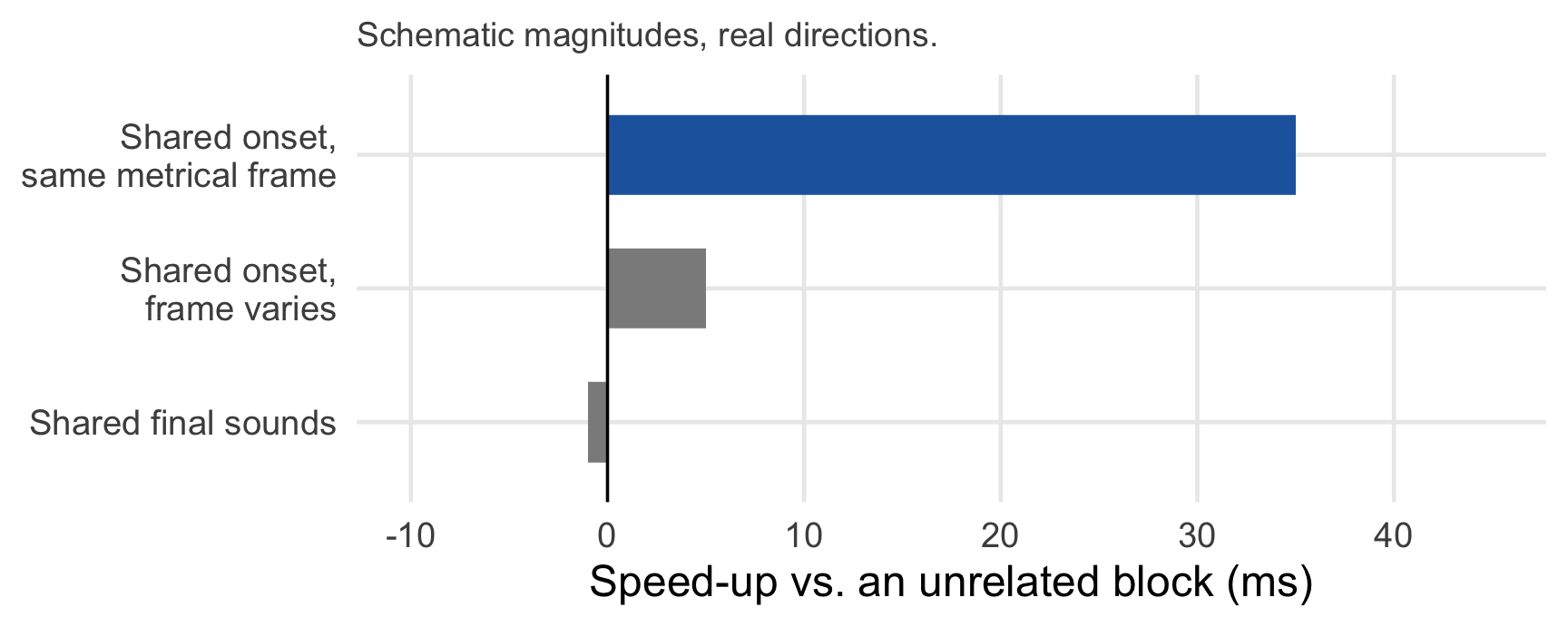
You can prepare a word prefix. You cannot prepare a word suffix.
Meyer 1990, 1991; Roelofs & Meyer 1998
Property 12: the problem for morphology
Suffixes are at the end. If the end is exactly the part you cannot prepare in advance, how is -ed ever ready on time?
And length effects mostly vanish once confounds are controlled. Multisyllabic words are not slower to prepare than monosyllabic ones.
Roelofs 1999; Griffin 2003; Bachoud-Levi et al. 1998
Property 13: similar sounds, no fixed sign
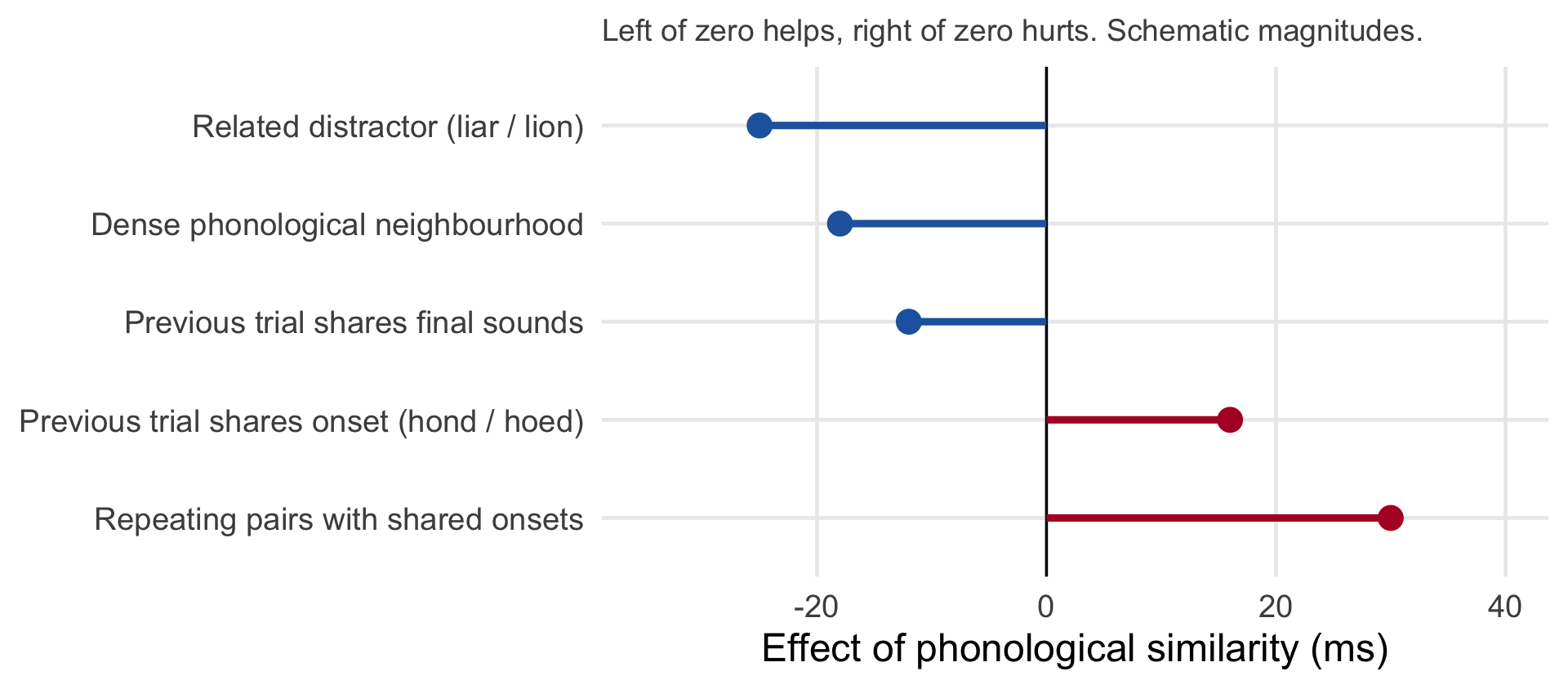
Vitevitch 1997, 2002; Schriefers et al. 1990; Sevald & Dell 1994; Wheeldon 2003
Property 13: why the sign flips
Semantically related words compete. Phonologically related words support each other, except when the task makes you sequence them.
- Retrieval of segments: support.
- Sequencing segments: competition. Finishing /i/ with /k/ makes finishing /i/ with /p/ harder.
So balaclava for baklava is probably not competition. It is a near miss: incomplete retrieval, defaulting to a similar stored form.
Dell & O’Seaghdha 1992; Burke et al. 1991
1.5 How discrete are the stages?
Strictly staged
Sound information is accessed only after selection finishes.
WEAVER++.
Cascading / interactive
Unselected candidates leak activation into sound assembly, and sounds feed back.
Dell 1986.
- Cascading: preparing to say couch, you are faster to read soda, because the losing synonym sofa activated its sounds.
- Feedback: semantic substitutions are phonologically more similar to their targets than chance. cat to rat, not cat to dog.
Property 14. Peterson & Savoy 1998; Levelt et al. 1999; Dell & Reich 1981
Property 14: the discrete reply
Mixed errors are not produced more often. They are caught less often.
An editor checks the output. The more the intruder resembles the target, the more likely it slips past.
Both accounts predict the same distribution of errors you observe. What experiment separates “generated more” from “detected less”?
Motley, Camden & Baars 1982; Levelt 1989; Rapp & Goldrick 2000
Property 15: message wide, sounds narrow
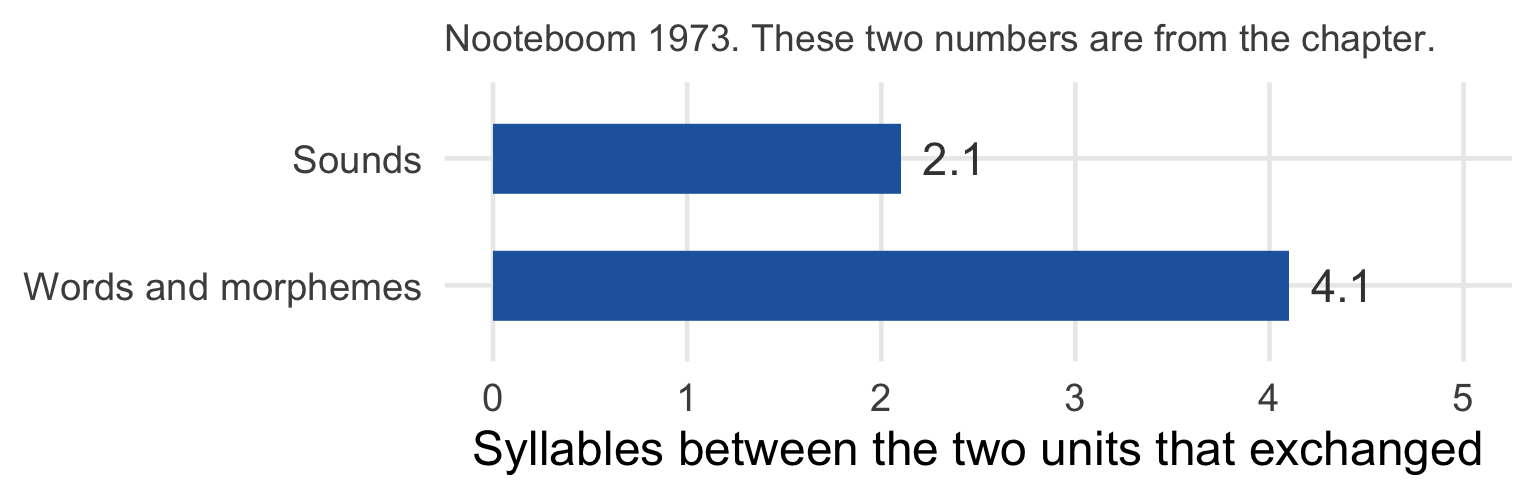
Abstract properties of words are settled further in advance than their sounds are.
Nooteboom 1973
What else says the message comes first
- Speakers start long utterances at a higher pitch than short ones.
- Complex clauses get more pauses and ums before them.
- Agreement errors cross clause boundaries less than they cross words.
You plan a proposition-sized message before you start. You do not plan all its words.
Cooper, Soares & Reagan 1985; Bock & Cutting 1992; Goldman-Eisler 1972
Property 15: how much do you prepare?
- Nouns after the verb are often selected while you are articulating the first words.
- Minimum unit looks like one phonological word: a content word plus its clitics, [beer’s a] [good] [thing].
- But: more if it is half a compound, more if it is inside the first noun phrase.
Griffin & Bock 2000; Wheeldon & Lahiri 1997, 2002; Martin & Freedman 2001
Property 15: and time itself
- Speakers insert optional that when the next word is slow to arrive.
- uh before short delays, um before long ones.
Planning scope is not a fixed constant. It is whatever keeps the mouth busy.
Ferreira & Dell 2000; Clark & Fox Tree 2002
What the chapter leaves out
The authors tell you themselves: they have not covered how speakers produce morphologically complex words.
So the only treatment of morphemes we get is Property 9, where they are filed next to articles because both depend on the words around them.
Meanwhile all of 1.4 assumes a word is a stem with sounds laid out in order, and Property 11 already told us that assumption breaks for Arabic.
Key takeaways
- Function words are selected by their neighbours, not by meaning.
- Sound form is assembled fresh, left to right, from segments plus a metrical frame.
- Experience shapes errors at both timescales, and it is language-specific.
- Semantic neighbours compete; phonological neighbours mostly help.
- Message planning runs ahead of sound planning, by about a phonological word.
Bring questions
- Property 12 says word endings cannot be prepared early. Property 9 says inflections depend on the stem. Are these the same fact?
- Where in this architecture would un- and -ness be stored?
- If phonological neighbours support each other, why do morphological families ever compete?
Reading questions due 11:59pm the night before