From an idea to a word
Griffin & Ferreira (2006), up to section 1.3
LING 449U, How words are built
2026-09-03
Where we are
- What we want: how complex words get built while you are talking.
- We need a core piece: how a single, simple word gets out of your mouth.
- Let’s write down your questions first.
Course schedule, Week 1
First, a game
Describe this picture
🐌 🍃
Write down random six words come to your mind.
- Nobody in this room wrote the same six words.
- It is clear that first two all of you shared: snail and leaves. but then?
Speaking is not listening, reversed
- Recognizing a word in your native language is fast, automatic, and needs no intention.
- Producing the same word needs an intention and takes up to five times longer.
Listeners start looking at the referent before the speaker has finished saying the word. Speakers need about 900 ms to start naming a pictured object.
Which is roughly how long it took you to get going on the snail.
Tanenhaus et al. 1995; Snodgrass & Yuditsky 1996
Keep in mind that
- Almost everything in this chapter is about single, isolated utterances. We set conversations, narratives, turn taking aside for a second.
- Almost everything is about nouns.
I want you to keep on asking if any of this would easily survive in other situations?
Levelt 1989; Clark 1996
The three steps
What are the ‘steps’ the chapter discusses?
The three steps
- Conceptualization, decide what to express
- Formulation, decide how to express it
- Articulation, say it
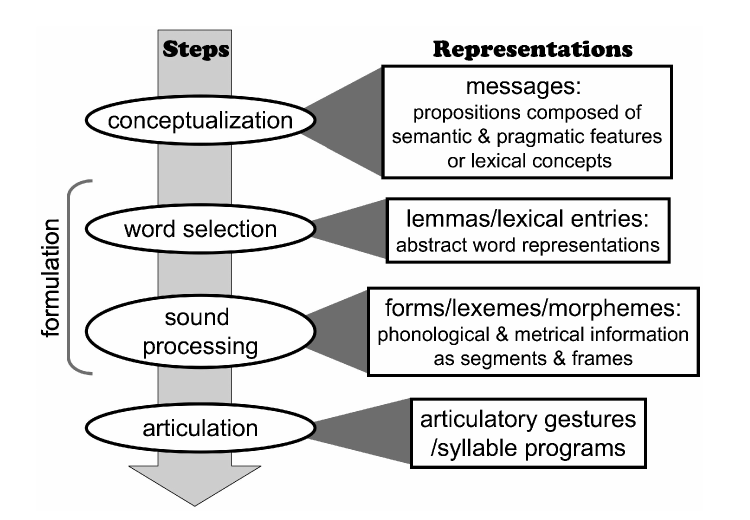
Levelt 1989. Figure 1, Griffin & Ferreira 2006:22
Properties in the chapter
- Property 1, the steps
- Properties 2 to 9, from meaning to word
- Properties 10 to 13, assembling the sounds
- Properties 14 and 15, how it all plays out in time
For today: we stop at Property 8, at the end of section 1.2.
1.1 Word selection precedes sound assembly
Property 1
Speakers access words by meaning first, then work on the sounds.
Two kinds of evidence:
- Speech errors come in types, and the types line up with the steps.
- Time course in picture and word interference.
Fromkin 1971; Garrett 1975
Errors come in types
| Error type | Example |
|---|---|
| Semantic word substitution | |
| Blend | |
| Phonological word substitution | |
| Morpheme substitution | |
| Sound substitution |
Table 1, Griffin & Ferreira 2006:24
Errors come in types
| Error type | Example |
|---|---|
| Semantic word substitution | “give him the yel- er the pink … the green jersey” |
| Blend | “Justi:ce, Justin and Travis” |
| Phonological word substitution | “the battle for the green journey [jersey]” |
| Morpheme substitution | “an awful lot of useless information. useFUL information” |
| Sound substitution | “the raid, uh, the roadie is accepting…” |
Table 1, Griffin & Ferreira 2006:24
Errors come in types
- Corpora like this are opportunistic. You get what people happen to say.
- The rates are low: roughly 2.5 word errors and 1.5 sound errors per 10,000 words of running speech.
Which errors do you think are undercollected, and why would that matter?
Deese 1984; Fromkin 1971
Why the types matter
- You can pick the wrong word and pronounce it perfectly.
- You can pick the right word and scramble its sounds.
- Those are two different failures, so there are two different steps.
Notice the fourth row. Morphemes substitute too, and they substitute separately from the stem. Hold onto that one.
Now we are going to run an experiment on you
The rules
- A picture appears. Say its name out loud, immediately.
- A word will appear on top of it. Ignore the word.
- Do not think very hard.
Picture and word interference: Schriefers, Meyer & Levelt 1990
Practice
RED
BLUE
GREEN
PURPLE
ORANGE
Practice 2
CLOUD
🪑
Website
https://www.utkuturk.com/pwi
Which one hurt?
The same trial, on a timer
picture
distractor
-400 ms -200 0 +200 +400
The time you introduce the distractor directly affects which step it interferes with.
Schriefers, Meyer & Levelt 1990; Glaser & Düngelhoff 1984
What people previously found (idealistic)
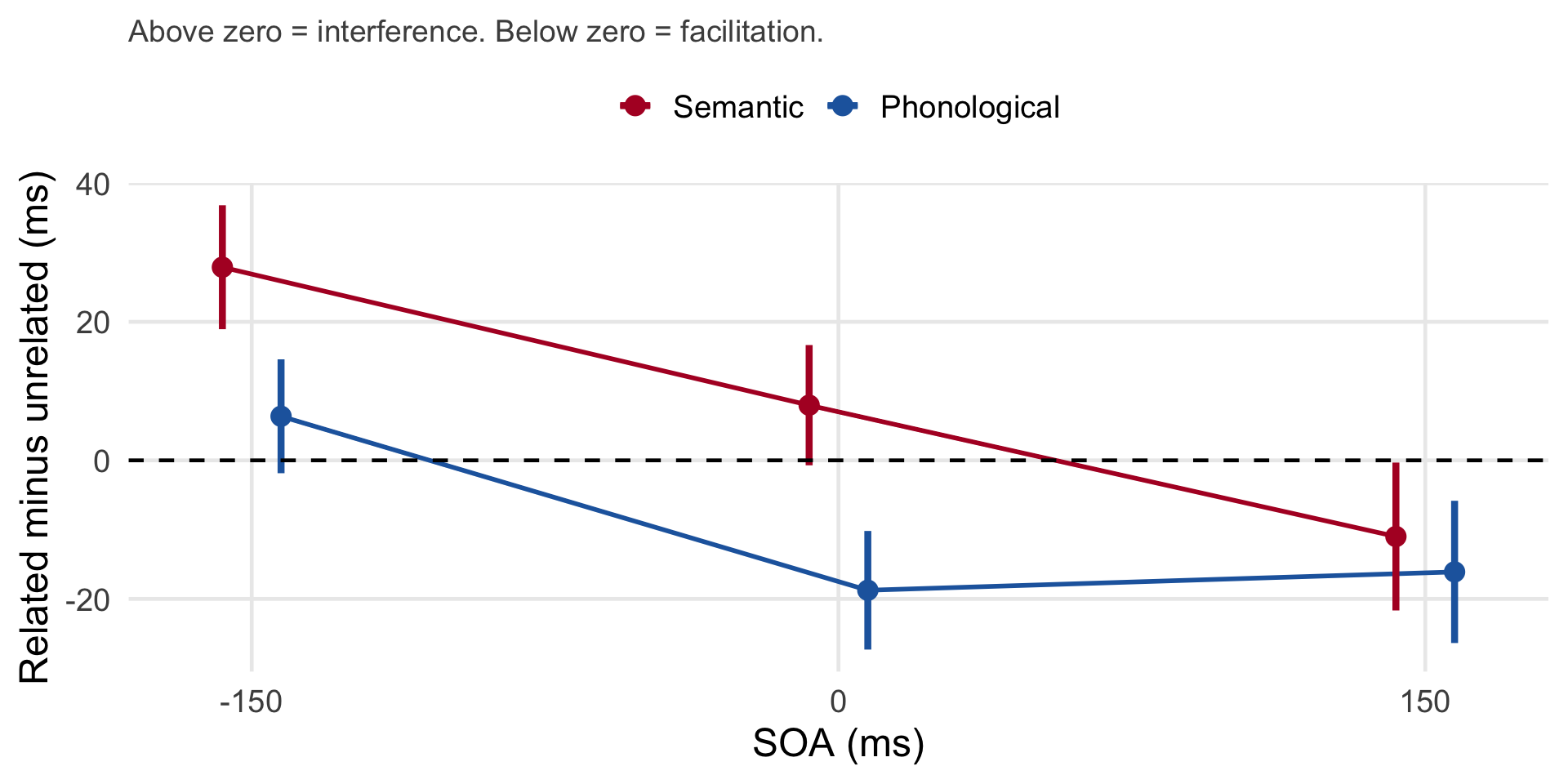
- Two stages, and two separate levels of representation: word level and sound level.
Glaser & Düngelhoff 1984; Damian & Martin 1999; Starreveld 2000
1.2 Selecting a content word
Property 2: a web of words
- Semantic substitutions: calling a van bus.
- Blends: behavior plus deportment gives behortment.
Of course, we fail at selecting the ‘exact’ word.
Which raises the obvious question: what is a meaning, in these models?
Dell et al. 1997; Garrett 1975; Wells 1951/1973
Two possibilities
Non-decompositional
BIRD is one atomic lexical concept.
Neighbours come from links in a network: BIRD to ANIMAL to FISH to fish.
Decompositional
bird = HAS WINGS, HAS FEATHERS, SINGS SONGS.
Neighbours come from shared features: airplanes have wings, opera singers sing.
Fodor 1975; Roelofs 1992; Levelt et al. 1999 (left). Dell 1986; Vigliocco et al. 2004 (right)
Two possibilities
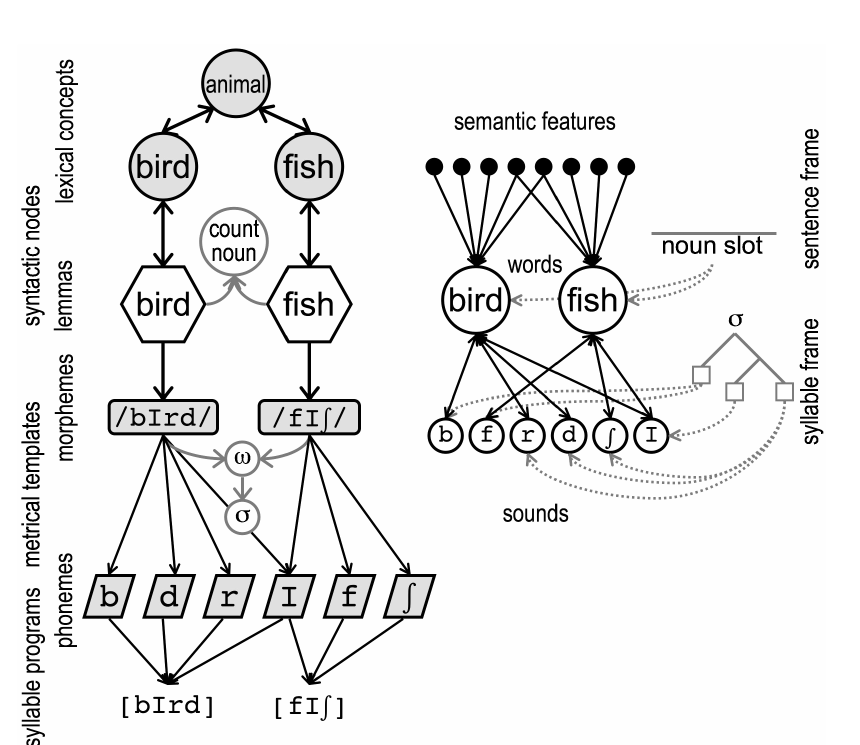
Figure 2, Griffin & Ferreira 2006:27. WEAVER++ (Levelt et al. 1999) left, Dell et al. (1997) right.
Two possibilities
- Decompositional gets similarity for free: overlap in features.
- Non-decompositional has to build similarity out of network links.
- Both have to explain why the neighbourhood is context dependent. Blends only involve words that are interchangeable in that sentence.
For us: if a morpheme carries meaning, which of these two boxes does -ed go in? Does PAST have features? (Look at Kandel & Pañeda et al. 2025)
Garrett 1975; Levelt 1989
Property 3: similar meanings compete
- Words that intrude in substitutions share grammatical class, taxonomic category, and level of specificity with the target.
- Related distractors slow you down relative to unrelated ones.
But sometimes dog and bone do not compete. Why?
Fromkin 1971; Nooteboom 1973; Cutting & Ferreira 1999; Lupker 1979
How models make words compete
- Activation only. Probability of selection tracks activation. Enough for error patterns, not enough for latencies.
- Lateral inhibition. The more active a word is, the harder it pushes the others down. Time to threshold is your reaction time. Kind of a race.
- WEAVER++. Two factors: a ratio of the target’s activation to everything else in the response set, plus a critical difference the target has to clear.
Dell 1986; Cutting & Ferreira 1999; Harley 1993; Levelt et al. 1999; Luce 1959
Property 3, a small case: codability
- tooth, bomb: one dominant name, so fast.
- TV or television, weights or barbells: two good names, so slow.
Lachman 1973; Lachman, Shaffer & Hennrikus 1974
Property 4: fenced in by grammatical class
- Nouns substitute for nouns, verbs for verbs.
- What about interchangable words?
- What about theories that says words are categoriless?
- Distractors interfere when they share grammatical class, verb transitivity, and other context relevant syntactic features.
- Even purely phonological substitutions tend to keep the category.
Property 4: one possible takeaway
The pressure to keep the grammatical class is stronger than the pressure to keep the meaning.
This is the first place syntax enters the model, and it enters as a frame with slots: a noun slot only accepts nouns.
Fromkin 1971; Garrett 1975; Schriefers 1993; Fay & Cutler 1977
Property 5: which meanings are easy
- Imageability and concreteness. vampire, wind, pine beat fear, sense, spirit.
- Predictability. The more predictable a word is in context, the fewer pauses and ums before it, and the faster the naming.
The twist: imageable words are produced faster and are more likely to be replaced by a semantically related word.
Richer meaning helps you find the word, and gives you more neighbours to trip over.
Morrison et al. 1997; De Groot 1989, 1992; Griffin & Bock 1998; Goldman-Eisler 1958
Property 5: exercise
- How can we explain these effects with decompositional or atomic meaning models?
Property 6: looking is not naming
- Distractor word banana while you say apple, that is interference.
- Distractor picture of a banana while you say apple, that is facilitation.
Words seem to get activated only when you intend to talk about the thing. Objects on their own do not push you into the lexicon.
Bloem & La Heij 2003; Damian & Bowers 2003
Property 6: except it is not clean
- Ignored objects show no semantic interference.
- But they do speed you up when their name sounds like your target, cap while naming a cat.
What does this suggest?
Every model routes phonology through the lemma. So if you got phonology from the ignored object, the lemma was active. And then where is the semantic interference?
Morsella & Miozzo 2002; Navarrete & Costa 2005
Property 7: selection leaves a trace
- Repetition priming for object naming lasts months.
- Perseveration: name a zebra, then call the giraffe zebra.
- Semantic homogeneity: naming many animals in a row gets slower.
- None of this happens if you just read the word aloud or categorize it. You have to select it from a meaning.
Reading, phonological assembly, and sentence production all have learning models. Word production does not. The authors name this as a gap.
Cave 1997; Bartram 1974; Vitkovitch & Humphreys 1991; Vigliocco et al. 2002
One more experiment. This one works on about half the room.
Do not say it out loud
What is the name of that tall guy who plays in Frankenstein?
If you have it, sit on it. If you are don’t remember it, raise your hand.
Hands up, answer these
- What letter does it start with?
- How many syllables?
- What does it rhyme with?
- Would you know it if I said it?
Property 8: stopping halfway
Tip of the tongue. You have the word and you cannot say it.
What people can still know in a TOT state:
- its first letter or sound, its number of syllables, words it rhymes with
- whether it is count or mass
- its grammatical gender in
- which auxiliary the verb takes
Anomia after brain damage looks the same: gender preserved, form gone.
Brown & McNeill 1966; Burke et al. 1991; Vigliocco, Martin & Garrett 1999
What do we need for TOT in our models?
Where the morphology is hiding
The chapter is about content words: nouns, mostly. Yet:
- Property 1. Morphemes substitute in speech errors, on their own, away from their stems. useless for useful.
- Property 4. Grammatical class constrains selection harder than meaning does. Class is a morphosyntactic fact.
- Property 8. In a TOT you can report gender and count or mass status without the form. You are holding morphosyntax with no morphology attached.
Even for a “single” words that are seemingly “single” nodes we need morphological information
Three questions to carry
- Every one of those observations is about a morpheme, and none of them get a mechanism in this chapter. Why not?
- Is a compound one selection or two?
- If Distributed Morphology is right and words are built by syntax, what happens to a stage called “word selection”?
Key takeaways
- Deciding what to say is its own step, and it is slow.
- Meaning first, sounds second, and never a shortcut between them.
- Selection is competitive, and the competition is over similar meanings inside the same grammatical class.
- The word can succeed while its form fails. That is a TOT.
- The models mostly agree on the facts. They differ on the mechanism.
Bring questions
- Property 1 says meaning based selection comes first. What would it look like if that was not the case ?
- Property 6: how would you tell “the word was never activated” apart from “the word was activated and then suppressed”?
- Name three things wrong with our experiment demo.
Reading questions due 11:59pm the night before